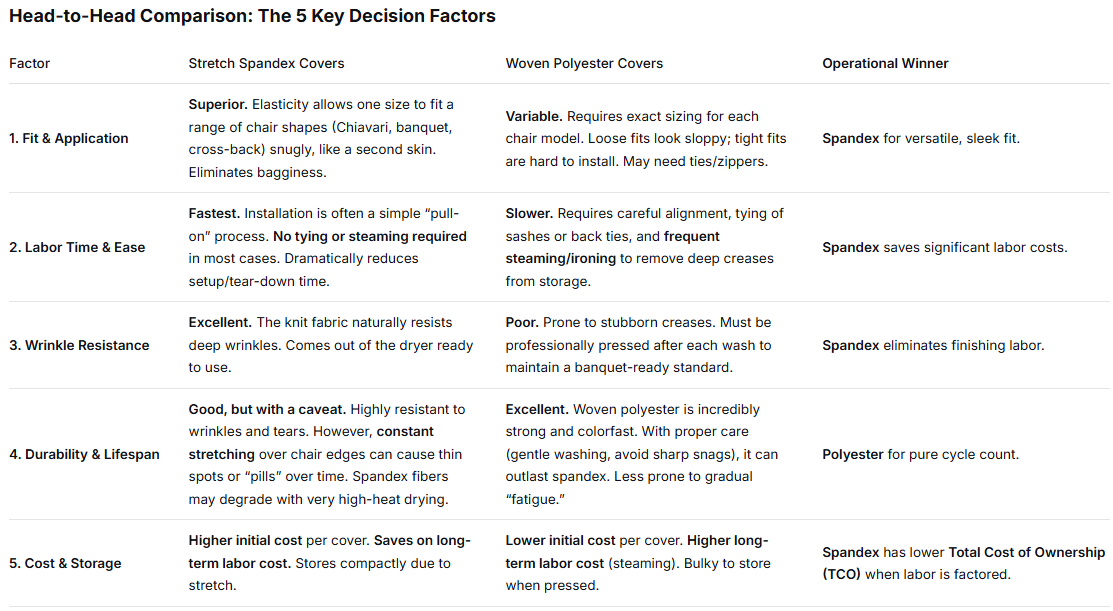
For hotel banquet managers and procurement teams, chair covers are more than decor—they are a significant labor investment. The wrong fabric choice can turn setup into a marathon of steaming, tugging, and adjusting, blowing through payroll hours. The two dominant options, Stretch Spandex (Knitted) and Woven Polyester, offer fundamentally different trade-offs between fit, labor efficiency, and long-term cost.
This Ulen guide cuts through the aesthetics to provide a data-driven comparison focused on operational impact, helping you choose the fabric that aligns with your team’s workflow and budget.
Core Difference: Elasticity vs. Structure
-
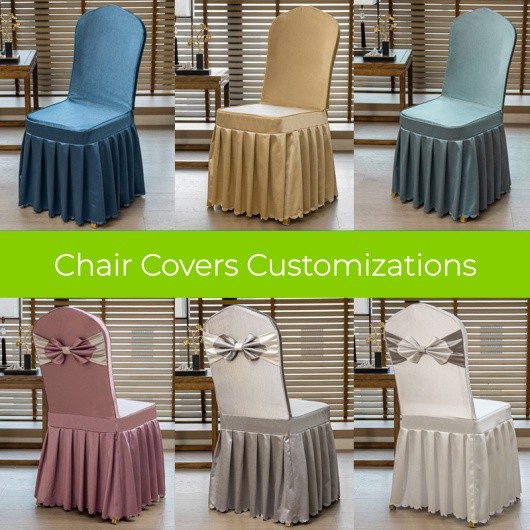
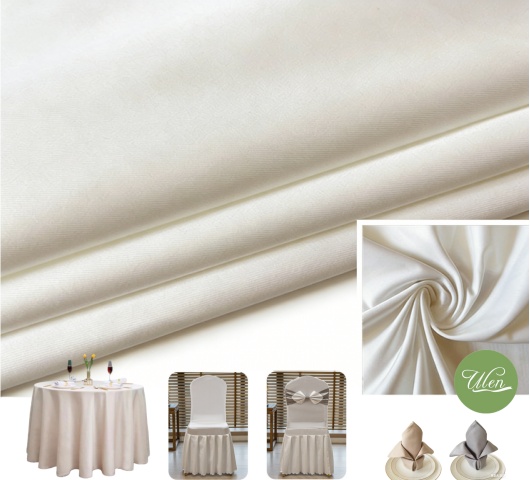
Stretch Spandex (e.g., 92% Polyester, 8% Spandex): A knitted fabric with significant elasticity. Designed to “stretch-fit” over chairs.
-
Woven Polyester: A traditional, non-stretch woven fabric. Relies on precise sizing, ties, or zippers for fit.
The Labor Cost Equation: Where the Real Money is Spent
Consider a 500-guest gala:
-
With Polyester Covers: A team of 4 might spend 1.5 hours steaming covers, plus 2 hours tying and adjusting during setup. Labor: 4 staff x 3.5 hours = 14 labor-hours.
-
With Spandex Covers: No steaming. Setup may take 1 hour for the same team. Labor: 4 staff x 1 hour = 4 labor-hours.
The Difference: 10 saved labor-hours. At $20/hour, that’s $200 saved per event on labor alone. This quickly justifies the higher purchase price of spandex.
Decision Matrix: Which Fabric is Right for Your Hotel?
Choose Stretch Spandex Covers If:
-
You host high-volume events with quick turnarounds (e.g., multiple banquets per day).
-
Labor cost and efficiency are your top concerns.
-
You have a variety of chair styles and want a single inventory.
-
You lack on-site steaming capability or want to free up laundry staff.
-
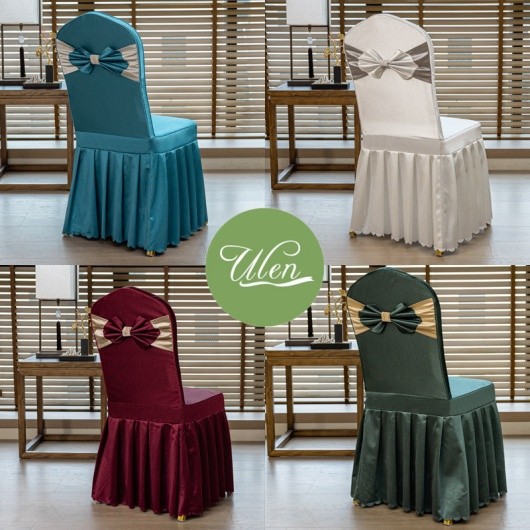
Your priority is a modern, sleek, “upholstered” look.
Choose Woven Polyester Covers If:
-
Your events are less frequent, and labor pressure is lower.
-
You have standardized chair models and can invest in perfectly sized covers.
-
Your priority is maximum fabric lifespan over 5+ years.
-
You prefer the classic, crisp “draped” look with tied bows or sashes.
-
Initial capital budget is extremely constrained (though TCO may be higher).
Pro Procurement Checklist
Before ordering, ask your supplier these questions:
For Spandex:
-
“What is the exact fiber composition (e.g., 92/8 Poly-Spandex)?”
-
“What is the weight/GSM of the knit? Can it withstand 200+ stretches without thinning?”
-
“What is the recommended drying temperature to preserve elasticity?”
For Polyester:
-
“Is the fabric inherently wrinkle-resistant, or treated?”
-
“Can you provide a sizing template for our specific chair model?”
-
“What is the thread count and denier? Is it stain-release treated?”
For Both:
-
“Can we get a sample for a live chair test and a commercial wash test?”
Conclusion: Invest in Time or Invest in Fabric
The choice between spandex and polyester is ultimately a choice between capital and labor expenditure.
-
Spandex is a capital investment that saves recurring labor costs. It is the choice for operational efficiency.
-
Polyester is a lower capital investment that incurs higher recurring labor costs. It is the choice for long-term asset ownership with available staffing.
For most modern hotels and venues focused on throughput and managing payroll, Stretch Spandex provides a superior return on investment through dramatic labor savings and a consistently professional, wrinkle-free appearance.
Ready to Specify? Contact Ulen for free Banquet Linen Fabric Specification Checklist to ensure your RFP captures all critical performance factors.
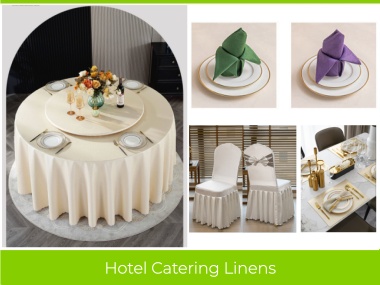
Ulen Linen specializes in premium event linens for weddings, galas, and corporate functions worldwide. With custom sizing, embroidery capabilities, and a commitment to quality, Ulen helps hotels and event professionals create unforgettable experiences. Contact us today to discover how we can elevate your next event.