
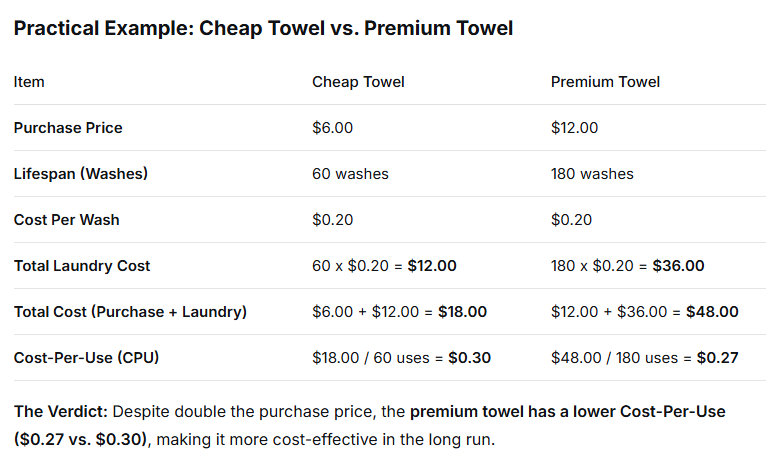
For hotel financial controllers and procurement managers, the true cost of linens isn’t just the price on the invoice. A cheap towel that wears out in 50 washes may be far more expensive than a premium one lasting 200 cycles. The key metric for intelligent budgeting is Cost-Per-Use (CPU).

This Ulen guide will walk you through the precise formula to calculate CPU for your hotel towels and bathrobes. We’ve even built a free, downloadable spreadsheet to automate the calculations for your team (see below).
Why Cost-Per-Use is the Only Metric That Matters
Traditional purchasing often focuses solely on the unit price. Cost-Per-Use reveals the long-term financial picture by factoring in durability and operational expenses. It helps you:
-
Justify Premium Purchases: A higher-quality hotel robe item with a lower CPU is a smarter investment.
-
Accurately Forecast Budgets: Move beyond guesswork to data-driven linen replacement forecasting.
-
Optimize Laundry Operations: Understand how washing frequency and costs directly impact your bottom line.
-
Compare Suppliers Objectively: Evaluate bids based on total value, not just upfront cost.
The Cost-Per-Use Formula: Breaking It Down
The CPU formula is straightforward but powerful:
Cost-Per-Use (CPU) = (Initial Purchase Cost + Total Laundry Cost) / Total Number of Uses
Let’s define each component:
1. Initial Purchase Cost:
This is the price you pay per item (e.g., $8.50 for a bath towel, $45 for a robe). Include any shipping or direct procurement fees.
2. Total Laundry Cost (The Hidden Expense):
This is the cumulative cost of washing the item over its lifetime. Calculate it as:
Number of Washes x Cost Per Wash
Number of Washes: The total usable lifespan of the item (e.g., a towel rated for 150 commercial washes).
Cost Per Wash: Your hotel’s actual cost to launder one pound/kilogram of hotel linen. This includes water, energy, detergent, labor, and machine depreciation. If unknown, industry averages ($0.15 – $0.30 per pound) can be used as a placeholder.

3. Total Number of Uses:
For towels, this is often equal to the Number of Washes, as they are typically laundered after each guest use. For robes, you may need to estimate uses between washes based on your housekeeping policy.
Contact Ulen Now to Get Our Free Hotel Linen CPU Calculator Spreadsheet
How to Use the Data for Smarter Procurement
-
Gather Accurate Data: Work with your laundry and housekeeping teams to get real numbers for wash cycle costs and observed bath linen lifespan.
-
Test Before You Buy: Always conduct a commercial laundry test with supplier samples. The promised “200-wash lifespan” is just a claim until proven.
-
Present to Decision-Makers: Use the CPU figure from the spreadsheet to build a compelling, financial case for quality purchases that reduce long-term operating expenses.
Conclusion: Invest in Data, Not Just Fabric
Shifting your focus from purchase price of hotel bath robes or towels to Cost-Per-Use transforms linen procurement from an expense into a strategic investment. It empowers you to cut long-term costs while improving guest comfort with more durable products.
FAQs – Hotel Towel & Robe Cost-Per-Use Guide: Calculate True Linen Expenses
1. What is Cost-Per-Use (CPU) for hotel towels and robes?
Cost-Per-Use (CPU) is a financial metric that calculates the total expense of a linen item over its entire lifespan, including purchase price and laundry costs, divided by the number of times it is used. It reveals the true long-term value of a towel or robe, going beyond the upfront unit price.
2. Why is Cost-Per-Use more important than unit price for hotel linens?
A low unit price can be deceptive. A cheap towel that wears out in 50 washes may cost more per use than a premium towel lasting 200 cycles. CPU accounts for durability and operational expenses, helping you justify quality investments and reduce long-term costs.
3. How do I calculate Cost-Per-Use for hotel bath towels?
Use the formula: CPU = (Initial Purchase Cost + Total Laundry Cost) ÷ Total Number of Uses.
-
Initial Purchase Cost: Price per towel including shipping.
-
Total Laundry Cost: Number of washes × cost per wash (water, energy, labor, detergent).
-
Total Uses: Typically equals number of washes for towels.
4. What laundry costs should I include in the CPU calculation?
Include water, energy (heating and drying), detergent, labor, machine depreciation, and any chemical treatments. Use your hotel’s actual cost per pound (or kg) of linen. If unknown, use industry averages ($0.15–$0.30 per pound) as a starting point.
5. How many wash cycles can I expect from a quality hotel bath towel?
A premium hotel bath towel (500–600 GSM, combed cotton or quality blend) typically lasts 150–250 industrial wash cycles. Lower-quality towels may fail in under 100 cycles. Always request supplier wash test data and verify with your own laundry test.
6. How do I calculate CPU for bathrobes if they are not washed after every use?
For robes, estimate total uses between washes based on your housekeeping policy. For example, a robe may be used 3–5 times before laundering. Multiply the number of washes by average uses per wash to get total uses, then apply the same CPU formula.
7. Can a more expensive towel actually have a lower Cost-Per-Use?
Yes. Example: Towel A costs $8 and lasts 80 washes ($0.10 per use). Towel B costs $15 and lasts 250 washes ($0.06 per use) – 40% lower CPU despite higher upfront cost. CPU reveals the smarter long-term investment.
8. How do I use CPU to compare different supplier bids?
Ask each supplier for expected wash cycle lifespan and use your standard laundry cost per wash. Calculate CPU for each bid. The bid with the lowest CPU (not lowest unit price) offers the best total value. Use our free spreadsheet to automate comparisons.
9. How can I verify a supplier’s claimed wash cycle lifespan?
Request a commercial laundry test sample and run it through 10–20 cycles in your own laundry. Check for shrinkage, colorfastness, pilling, and seam integrity. A confident supplier will provide test reports or pre-washed samples. Never rely on claims without validation.
10. What is a typical laundry cost per pound for hotel linens?
Industry averages range from $0.15 to $0.30 per pound (approximately $0.33 to $0.66 per kg). Actual costs vary by region, utility rates, equipment efficiency, and labor. Work with your laundry provider to get accurate numbers for your property.
11. How does CPU help with linen replacement forecasting?
Once you know the CPU and expected wash cycles of your current linens, you can predict exactly when replacement is needed. Multiply CPU by annual occupied room nights to budget for future purchases. This turns guesswork into data-driven financial planning.
12. Should I calculate CPU differently for pool towels vs. guest room towels?
Yes, because laundry frequency and environment differ. Pool towels may be washed after each use but face harsher conditions (chlorine, sand). Use the same formula but with adjusted lifespan estimates based on your pool towel durability tests. Typically, lower‑GSM quick‑dry towels have a shorter lifespan.
13. What is the biggest mistake hotels make when calculating CPU?
Underestimating laundry costs. Many hotels forget to include labor, machine depreciation, or chemical treatments. Also, using supplier lifespan claims without testing leads to inaccurate CPU. Always verify with your own wash test and use fully loaded laundry costs.
14. How do I present CPU data to my finance team to justify better linens?
Prepare a side‑by‑side comparison showing:
-
Current towel (price, cycles, CPU)
-
Proposed premium towel (higher price, longer cycles, lower CPU)
-
Annual savings (current CPU – proposed CPU) × annual uses
-
Payback period (extra upfront cost ÷ annual savings)
This financial case proves that spending more upfront reduces operating expenses.