For hotel owners and procurement managers, every detail in the bedroom impacts both the guest experience and the bottom line. The choice between a flat sheet and a fitted sheet is more than a matter of preference—it’s a decision that affects housekeeping efficiency, linen longevity, and operational costs.
This guide breaks down the key differences in durability and labor costs to help you choose the right sheet system for your hotel.
Understanding the Basics: Construction & Use
-
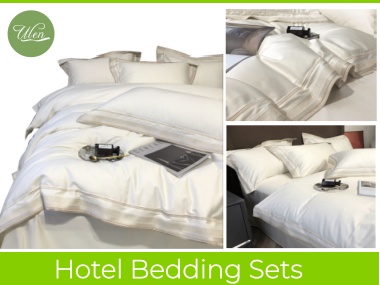
Fitted Sheet: Designed with elasticized corners to snugly fit over a mattress. It stays securely in place, providing a smooth sleeping surface.
-
Flat Sheet: A rectangular sheet placed directly over the fitted sheet, tucked in on the sides and foot of the bed. In many European-style makings, it’s used as a top sheet; in some traditional American makings, it can also be used as a bottom sheet (with hospital corners).
Head-to-Head Comparison: Durability & Labor
1. Durability & Lifespan
-
Fitted Sheet:
-
Weak Point: The elastic and the stitched corners. These are high-stress areas that can fail first, with elastic losing its stretch or seams tearing after repeated industrial washing and aggressive fitting.
-
Material Stress: The constant tension can cause the fabric at the corners to thin and wear out faster than the center.
-
-
Flat Sheet:
-
More Forgiving: With no elastic or complex seaming, a flat sheet is structurally simpler. Wear and tear is more evenly distributed across the entire sheet.
-
Longer Potential Lifespan: A high-quality flat sheet, when rotated and cared for properly, can often outlast a fitted sheet. Damaged edges can sometimes be hemmed, extending its life further.
-
Verdict on Durability: Flat sheets generally have a longer potential lifespan due to their simpler construction and lack of stress points like elastic.
2. Labor Cost & Housekeeping Efficiency
-
Fitted Sheet:
-
Easier and Faster to Install: Housekeeping staff can quickly pop the fitted sheet onto the mattress. It requires less precision and skill than tucking a flat sheet tightly.
-
Consistent Look: When properly sized, it guarantees a neat, tailored appearance on the bed with minimal effort.
-
-
Flat Sheet (as a bottom sheet):
-
Higher Skill & Time Requirement: Making a bed with a flat sheet as the bottom layer requires mastering “hospital corners” to achieve a tight, professional finish. This process is more time-consuming and labor-intensive.
-
Inconsistency Risk: The final look depends heavily on the housekeeper’s skill and care, potentially leading to a less uniform standard across rooms.
-
Verdict on Labor Cost: Fitted sheets are the clear winner for operational efficiency. They reduce bed-making time, lower training requirements, and ensure a consistent, secure fit that stays neat.
The Guest Comfort & Perception Factor
-
Guest Preference: This varies regionally. Many guests associate fitted bottom sheets with a secure, neat bed. Flat top sheets are often preferred for their breathability and the ability to be easily adjusted.
-
The Hybrid Standard: Most modern hotels use a fitted sheet as the bottom layer and a flat sheet as the top layer, combining the efficiency of a fitted sheet with the adjustability and traditional feel of a flat sheet.
Key Procurement Considerations for Your Hotel
-
Calculate Total Cost of Ownership (TCO): Don’t just look at unit price. Factor in:
-
Replacement Rate: Will fitted sheets need replacing more often due to elastic failure?
-
Labor Cost: How much time (and therefore wages) does each system add to room turnover?
-
-
Test Your Laundry Process: Submit both types of sheets to a commercial laundry test. See how the elastic in fitted sheets holds up over 100+ washes. Check for fraying on flat sheet edges.
-
Consult Your Housekeeping Team: They are the experts on the ground. Which system allows them to work faster and achieve the desired standard? Their input is invaluable for a smooth rollout.
Recommendation: Which System is Best for Your Hotel?
-
Choose a Fitted Bottom Sheet + Flat Top Sheet System if:
You prioritize housekeeping efficiency, speed, and a consistently neat bed appearance. This is the industry standard for a reason—it optimizes labor costs while meeting guest expectations. -
Consider an All-Flat Sheet System (with hospital corners) if:
You are a luxury or boutique heritage property where traditional craftsmanship is part of the brand, and you have the training infrastructure to maintain a high standard. The potential for extended linen lifespan may offset higher labor costs.
Conclusion: Balance Efficiency with Longevity
For the majority of hotels, the operational savings from using fitted bottom sheets far outweigh the potential durability advantage of flat sheets. The reduction in labor time per room translates directly to lower costs and faster turnover.
Final Procurement Tip: If you choose fitted sheets, invest in high-quality elastic and reinforced corners. This upfront investment will maximize their lifespan, protecting your operational efficiency gains over the long term. Always pair your decision with a rigorous laundry testing protocol to validate durability claims.