When sourcing bed sheets for your hotel, “thread count” is often presented as the ultimate measure of quality. Suppliers tout 600, 800, even 1000 thread count sheets as the pinnacle of luxury and durability. But for a hotel procurement manager, the equation is different. In a commercial setting where sheets face industrial washing daily, is a higher thread count truly better for durability and value?
This guide cuts through the marketing hype to reveal what thread count really means for hotel operations, helping you make a purchase that balances guest comfort with long-term cost control.
What is Thread Count? A Quick Definition
Thread count (TC) refers to the number of horizontal (weft) and vertical (warp) threads woven into one square inch of fabric. Generally, a higher count indicates a denser, smoother weave.
The Commercial Reality: For hotels, thread count is just one factor—and beyond a certain point, it can become a disadvantage. Fiber quality, yarn strength, and weave construction matter more for longevity.
The Myth of “Higher is Better” in Hospitality
The common belief is: Higher TC = Softer, More Durable, More Luxurious.
For hotels, this is often false. Here’s why:
-
The Ply Deception: To inflate thread count numbers, some manufacturers use multi-ply yarns (twisting two or three thinner strands together). A sheet made with 2-ply yarns can double the stated thread count (e.g., 250 two-ply threads become “500 TC”). These sheets can be thicker, less breathable, and more prone to pilling.
-
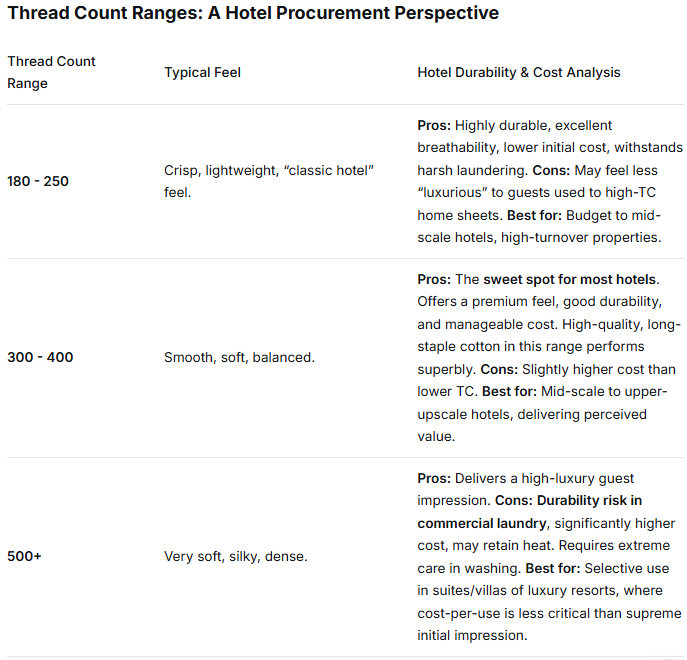
Durability vs. Density: Extremely high thread counts (e.g., 800+) result in very fine, tightly woven threads. While silky to the touch initially, these delicate fibers may not withstand the abrasive, high-temperature environment of a commercial laundry. They can tear, thin, or develop holes faster than a robust, medium-count sheet.
-
Breathability & Guest Comfort: Overly dense weaves can trap heat, leading to a less breathable sleep surface—a common guest complaint in warmer climates.
What Matters More Than Thread Count for Hotels
-
Fiber Quality (The “Staple”): Long-staple cotton (like Egyptian, Pima, or Supima®) is the gold standard. Longer fibers create stronger, smoother yarns that resist pilling and tearing, making even a 300 TC sheet outlast a 600 TC sheet made of short-staple cotton.
-
Weave Construction: A percale weave (one-over-one-under) is crisp, breathable, and incredibly durable for hotels. Sateen weaves (three-over-one-under) are softer and silkier but can be less durable due to the longer surface floats that are prone to snagging.
-
Commercial Laundry Testing: This is non-negotiable. A sheet’s true value is its lifespan in your laundry. Always test samples for:
-
Tensile Strength: Does it tear easily after 50+ washes?
-
Pilling: Does the surface develop fuzz balls?
-
Color/Whiteness Retention: Does it look dingy over time?
-
Shrinkage Control: Consistent sizing is crucial for housekeeping efficiency.
-
Your Hotel’s Thread Count Strategy: Actionable Steps
-
Define Your Priority: Is it maximum durability/lowest cost-per-use, or peak guest impression? For 90% of rooms, durability should win.
-
Request Detailed Specs: Ask suppliers for: Fiber origin and staple length, Single-ply vs. multi-ply yarns, Weave type, AND independent wash test reports.
-
Conduct Your Own “Pill Test”: Rub a piece of fabric vigorously between your fingers for 10 seconds. If it starts to pill immediately, it will not survive commercial laundry.
-
Think “Touch,” Not Just Number: Let your housekeeping and management team feel blind samples. The sheet that feels substantial and smooth while being no higher than 400 TC is likely your best investment.
Conclusion: The Optimal Choice for Hotel Durability
For hotel durability and total cost of ownership, a higher thread count is not better.
The ideal hotel sheet is a 300-400 thread count, made of long-staple cotton in a percale weave. This combination delivers the perfect balance of guest-perceived luxury, breathability, and most importantly, the resilience to survive 150-200+ commercial laundry cycles.
Shift your procurement focus from chasing a thread count number to verifying fiber quality, weave integrity, and real-world laundry performance. This data-driven approach will reduce your linen replacement budget and ensure guest comfort for years.
Ready to Spec Your Sheets?
Download our free Hotel Bed Linen Specification Checklist to ensure your next RFP gets you the durable, cost-effective quality you need.
[>>> Download Your Free Specification Checklist <<<]