Hotel Sheet Procurement: The Definitive Cotton vs. Microfiber Guide for Durability & Cost
Selecting the right bed sheets is a critical operational decision for any hotel. The choice between cotton and microfiber impacts not only guest sleep quality but also your annual linen budget, laundry operations, and long-term capital expenditure. As a procurement professional, you need a decision based on total value, not just price tags.
This guide provides a data-driven comparison of cotton and microfiber sheets, focusing on commercial durability, true cost-per-use, and operational impact to help you specify the right fabric for your property.
Core Fabric Differences: Natural vs. Engineered
-
Cotton: A natural fiber (like Egyptian or Supima®) known for breathability, a classic crisp feel, and a premium reputation. Its performance depends on staple length and weave.
-
Microfiber: A synthetic fabric made from finely woven polyester threads. It is engineered for softness, wrinkle resistance, and moisture-wicking.
Head-to-Head Analysis: The 5 Procurement Decision Factors
1. Durability & Lifespan in Commercial Laundry
-
High-Quality Cotton: Extremely durable when made with long-staple fibers and a percale weave. Can withstand 150-200+ commercial washes if laundered correctly. However, it is susceptible to damage from excessive bleach and high heat.
-
Microfiber: Highly resistant to pilling, fading, and shrinkage. The tight synthetic weave stands up well to frequent washing. However, it can be prone to snagging from sharp objects, and the surface may “polish” or lose its softness over an extended period of very high-temperature drying.
-
Verdict: It’s a tie, but for different reasons. Both can be durable, but cotton’s longevity is tied to fiber quality and gentle washing, while microfiber’s is tied to snag prevention and controlled drying.
2. Total Cost of Ownership (Cost-Per-Use)
This is the most critical calculation. Cost-Per-Use (CPU) = (Purchase Price + Total Laundry Cost) / Lifespan (in uses).
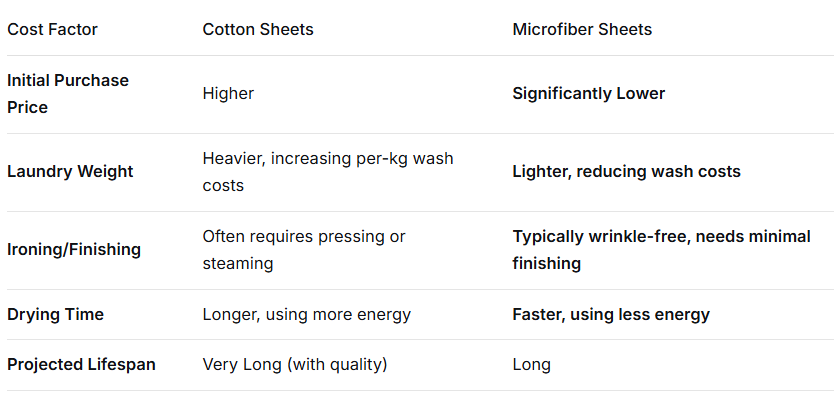
Overall Verdict on Cost: Microfiber almost always wins on pure operational cost-efficiency. Its lower acquisition cost, reduced laundry weight, and elimination of ironing labor lead to a lower Cost-Per-Use in most high-volume scenarios.
3. Guest Comfort & Perception
-
Cotton: Breathable, temperature-regulating, and moisture-absorbent. It feels cool in summer and warm in winter. Associated with luxury and high-end hotels.
-
Microfiber: Has a very soft, sometimes silky feel. It is less breathable than cotton, which can lead to a warmer sleep experience—a potential negative in hot climates. Some guests perceive it as “less premium” than natural cotton.
-
Verdict: Cotton wins for breathability and luxury perception. Microfiber wins for consistent softness and a “hotel crisp” look without wrinkles.
4. Operational & Housekeeping Workflow
-
Microfiber: The clear operational winner. Sheets come out of the dryer ready to use, saving massive time and labor in the finishing department. They are also easier for housekeeping staff to handle and bed-make due to their lighter weight.
-
Cotton: Requires a dedicated finishing process (ironing/steaming) to meet luxury standards. Adds complexity and labor cost to the laundry workflow.
5. Sustainability & Hygiene
-
Cotton: A natural, biodegradable resource (especially if organic). However, its cultivation is water-intensive.
-
Microfiber: Made from petroleum-based polyester. It sheds microplastics in washing. On the plus side, its low-temperature wash compatibility reduces energy consumption.
Procurement Recommendation Matrix
Choose Premium Cotton (300-400 TC Percale) if:
-
Your brand is Luxury, Boutique, or Upper-Upscale.
-
Guest sleep experience and luxury perception are paramount.
-
You have the laundry infrastructure for gentle processing and finishing.
-
You are marketing a cool, breathable sleep environment.
Choose High-Quality Microfiber if:
-
Your segment is Mid-scale, Extended-Stay, or Budget/Economy.
-
Controlling operational costs and labor is the top priority.
-
You have high occupancy and need rapid room turnover.
-
You want a consistently neat, wrinkle-free bed appearance with minimal effort.
Consider a Hybrid Strategy:
Use microfiber for your standard room inventory to control costs. Use premium cotton in suites and upgraded room categories to elevate the experience. This optimizes both budget and guest perception.
Actionable Steps Before You Buy
-
Get Physical Samples: Feel and compare the actual fabrics.
-
Run a Laundry Test: Wash and dry each sample 25-50 times in YOUR commercial laundry. Assess pilling, shrinkage, and feel.
-
Calculate CPU: Use our free Cost-Per-Use Calculator [Link to previous article’s tool] to model 3-year costs for both options.
-
Survey Your Guests: If possible, gauge preference through comment cards or surveys.
Conclusion: Align Fabric with Function
There is no universal “best” choice—only the best choice for your specific hotel operation. By weighing dubility, Cost-Per-Use, guest expectations, and operational workflow, you can move beyond the cotton vs. microfiber debate to a strategic, data-backed procurement decision.
For most hotels focused on efficiency and value, high-quality microfiber presents an unbeatable operational advantage. For hotels where the sleep experience defines the brand, investing in premium cotton is a non-negotiable standard.
Ready to specify? Download our Hotel Linen Specification Checklist to ensure your next RFP covers all critical durability and performance factors.