Executive Summary: Confronted with tightening operational budgets and variable guest feedback on linen quality, an independent 45-room boutique hotel initiated a strategic overhaul of its linen procurement and management. Within one fiscal year, the property achieved a sustained 20% reduction in total annual linen expenditure while simultaneously improving product quality and guest satisfaction scores. This detailed case study outlines the proven four-step methodology, actionable tactics, and quantified results.
1. The Pre-Intervention Challenge: Symptoms of a Costly System
Prior to the change, the hotel’s linen operation exhibited several common yet financially draining inefficiencies:
-
Fragmented and Reactive Purchasing: Bedding, bath linens, and table linens were sourced from multiple vendors based on piece-price, leading to complex logistics, higher shipping costs, and inconsistent quality.
-
High Hidden Costs: The focus on low unit price disguised the true expense of frequent replacements, excessive safety stock, and administrative labor for managing numerous orders and SKUs.
-
Inconsistent Guest Experience: Online reviews occasionally cited issues like “thin towels” or “pilled sheets,” directly contradicting the hotel’s desired premium positioning.
-
Data-Deficient Decisions: Procurement choices were made without understanding Total Cost of Ownership (TCO) or the actual lifespan of items in a commercial laundry cycle.
The mandate was clear: Systematically lower total linen spend while elevating quality standards and operational simplicity.
2. The Strategic Blueprint: A 4-Phase Operational Transformation
Phase 1: Deep-Dive Audit & Total Cost of Ownership (TCO) Enlightenment
The team began by rigorously measuring the status quo.
-
Inventory & Usage Analysis: A 90-day tracking period mapped the flow of every linen type, establishing accurate par levels, measuring replacement frequency, and identifying shrinkage.
-
Holistic Cost Mapping: All associated costs were captured—purchase price, per-order freight charges, administrative processing time, and labor for sorting and stocking multiple product lines.
-
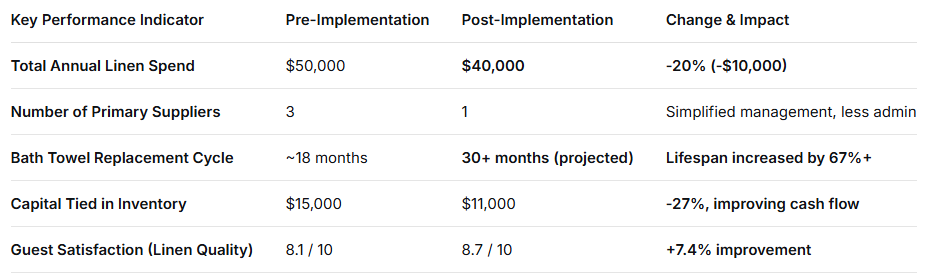
The Key Insight: Analysis revealed that their “low-cost” towels (low GSM) required replacement twice as fast as a mid-weight alternative. When calculating cost-per-use, the cheaper towels were actually 40% more expensive over time.
Phase 2: Strategic Supplier Consolidation & Partnership
With data in hand, the hotel transitioned from a multi-vendor model to a single-source partnership.
-
TCO-Driven Request for Proposal (RFP): The new RFP required suppliers to provide laboratory test data on durability (e.g., pilling, tensile strength after 100+ washes) and OEKO-TEX certification, prioritizing lifecycle performance over upfront price.
-
Leveraging Volume for Value: By consolidating all linen categories into one comprehensive, multi-year agreement, the hotel gained significant negotiating power for bulk pricing and simplified its supply chain.
-
Selecting a Capable Partner: They chose a vertically integrated manufacturer known for transparency, consistent quality, and the ability to provide complete product line solutions.
Phase 3: Product Rationalization & Smart Re-specification
The hotel simplified its inventory based on performance data, not assumptions.
-
Drastic SKU Reduction: The number of towel types was cut from five to two (a durable 550 GSM bath towel and a quick-dry 400 GSM pool towel). All guest rooms adopted a single, standardized bedding set configuration.
-
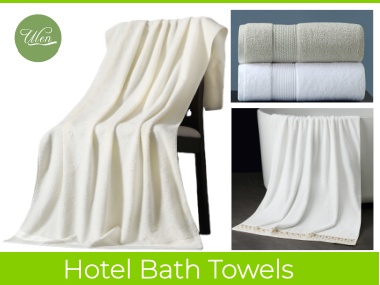
Intelligent Specification Upgrades: They switched to a high-performance cotton-polyester blend for sheets for superior wrinkle resistance and lifespan, and selected combed cotton towels for the optimal balance of softness, absorbency, and durability.
-
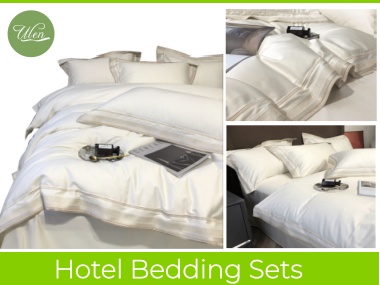
Adopting Set-Based Procurement: Purchasing complete bedding sets (fitted sheet, flat sheet, pillowcases) as one SKU eliminated mismatched components and dramatically streamlined inventory management.
Phase 4: Process Optimization: Inventory Control & Care Protocols
To maximize the return on their new investment, internal processes were refined.
-
Data-Backed PAR Level Adjustment: Using historical occupancy and laundry turnaround data, they optimized stock levels across rooms, housekeeping closets, and the linen room, freeing up working capital.
-
Laundry Process Alignment: Collaborating with their laundry service, they reviewed wash formulas, temperatures, and chemical use to implement gentler cycles that extend textile life.
-
Staff Engagement & Training: Housekeeping teams were trained on proper handling and given a simple system to flag items for retirement, preventing damaged linens from reaching guests.
3. Quantifiable Outcomes & Financial Return
The results, measured after 12 months of full implementation, were significant.
Additional Strategic Gains:
-
Operational Efficiency: Drastic reduction in time spent on ordering, receiving, and inventory counts.
-
Brand Assurance: Consistent, high-quality presentation in every guest room.
-
Predictable Forecasting: Accurate budgeting with fewer unforeseen replacement purchases.
4. Universal Lessons for Hoteliers
This boutique hotel’s success hinged on a fundamental shift from tactical price shopping to strategic value management.
-
Unit Price is a Mirage: Total Cost of Ownership (TCO) and Cost-Per-Use are the only metrics that reveal true value.
-
Simplicity Drives Savings: Consolidating suppliers and standardizing products are the most effective levers for reducing cost and complexity.
-
Partner with Proof: Choose suppliers who provide verifiable performance data and transparency, not just attractive catalogs.
-
Protect Your Assets: Optimize internal inventory and laundry practices to maximize the lifespan of quality textiles.
Conclusion: Quality as the Catalyst for Savings
This case study demonstrates that higher initial investment in properly specified products, guided by data and supported by a strategic partnership, directly enables substantial long-term savings. By reallocating funds from constant, wasteful replacement cycles to fewer, higher-quality purchases, the hotel enhanced its guest experience while significantly strengthening its operational efficiency and profitability.
Is Your Hotel Ready to Transform Its Linen Economics?
Our model is specifically designed to help hotels achieve these exact outcomes through consolidated sourcing, TCO-optimized products, and data-driven planning.
Contact us for a Confidential Linen Spend Analysis. Share your current challenges, and we will provide a personalized assessment of your potential savings opportunity.