
For hotel procurement managers, every linen purchase is a series of calculated trade-offs. Bath linens—towels, robes, and mats—present a unique challenge: they are high-visibility items that directly impact guest comfort and perception, yet they face relentless wear in commercial laundry cycles. Blindly investing in “the best of everything” erodes profits, while excessive saving risks guest satisfaction and increases long-term replacement costs.
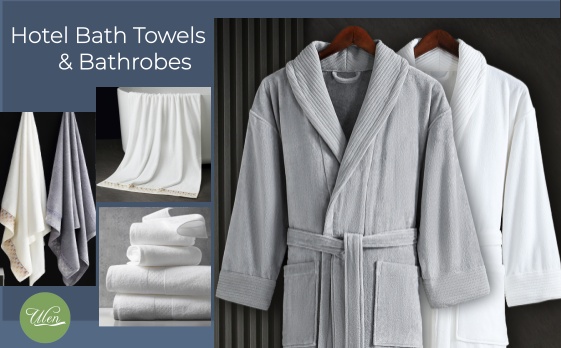
The solution lies in strategic allocation. This guide provides a clear, actionable framework for deciding exactly when to invest and when to save on each type of bath linen, ensuring your budget prioritizes what matters most to your guests and your bottom line.
The Guiding Principle: Invest in Experience and Durability, Save on Complexity
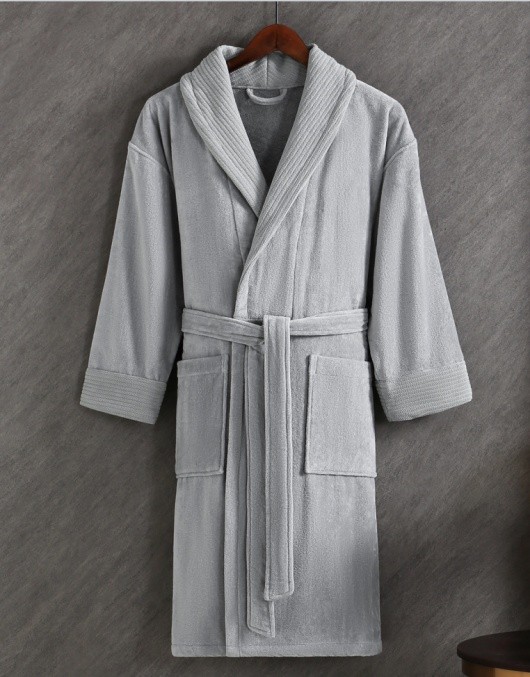
Direct your investment toward elements that either: 1) Create a memorable, positive sensory experience for the guest, or 2) Are critical to the hotel bathrobe product’s longevity and core function. Save on features that are less perceptible or prone to standard wear.
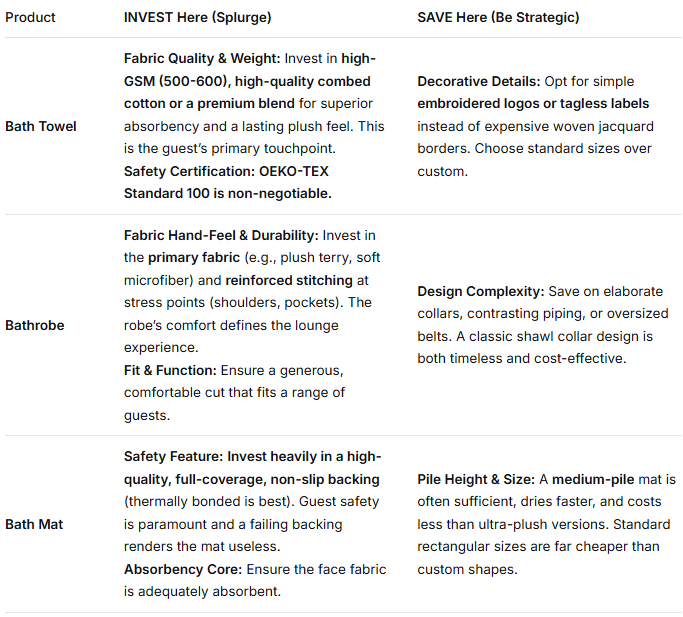
Investment vs. Save Decision Matrix
The following table breaks down the key decision points for each product category.
Strategic Application: Decision Frameworks for Smart Spending
When You Must INVEST (The “Non-Negotiables”):
-
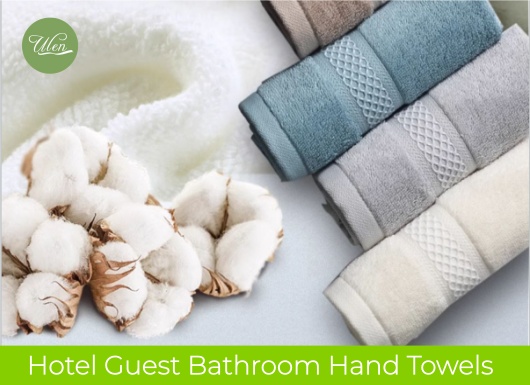
In the “First-Impression” Layer: The part of the towel or robe that the guest touches first should have a premium feel. This justifies investment in top-tier fabrics.
-
In Structural Integrity: Any component critical to preventing premature failure is worth the cost. This includes towel hems, robe seams, and mat backing.
-
In Safety and Hygiene: Any feature that protects guest safety (non-slip backing) or ensures fabric safety (OEKO-TEX certification) is an essential investment, not an option.
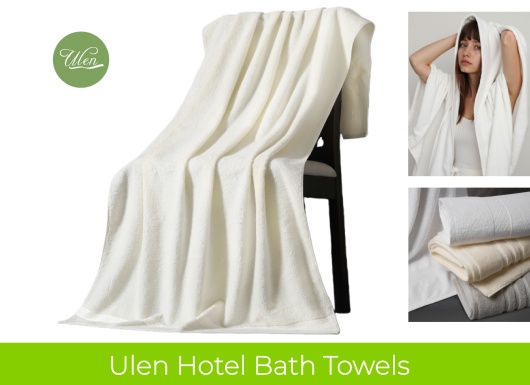
Where You Can Confidently SAVE:
-
On “Second-Layer” or Non-Critical Features: The side of the towel not facing up, or the interior lining of a robe pocket, can utilize a good-quality but less expensive material.
-
On Standardization: By standardizing colors and styles across your property, you achieve bulk purchasing power, which lowers the unit cost on every item—a form of smart saving.
-
By Simplifying Design: Eliminate purely decorative elements that add cost without enhancing function or the core guest experience.
The Universal Baseline: What Never to Compromise On
Regardless of your “save” decisions, these elements are mandatory for any reputable hotel operation:
-
Commercial Laundry Resilience: Every item must survive industrial washing without catastrophic failure, excessive shrinkage, or dramatic fading.
-
Operational Practicality: All hotel linens must be machine-washable, dryable, and designed for efficient housekeeping handling and folding.
-
Professional Finish: Even cost-effective items must be well-finished, with no loose threads or uneven stitching, to maintain a professional appearance.
Conclusion: From Cost Center to Value Engine
Viewing bath linen procurement through the “invest vs. save” lens transforms it from a routine expense into a strategic management exercise. By deliberately channeling funds toward durability, safety, and key guest touchpoints, you build a bath linen program that maximizes perceived luxury while optimizing your total lifecycle spend. This disciplined, value-driven approach is the hallmark of a financially savvy and guest-centric hotel.
Need Help Optimizing Your Bath Linen Budget?
Our expertise is helping hotels develop strategic linen programs that balance investment with savings. We offer tiered product lines that align perfectly with this framework, providing premium quality where it counts and intelligent value elsewhere.
Contact us for a Custom Bath Linen Budget Audit. We’ll analyze your current spending and provide a tailored plan showing precisely where to reallocate resources for better guest reviews and a stronger return on investment.
FAQs: Hotel Bath Linens: When to Invest vs. Save on Towels, Robes & Mats – A Procurement Manager’s Guide
1. What is the guiding principle for deciding when to invest vs. save on hotel bath linens?
Invest in guest experience and durability; save on complexity and low-impact features. Prioritize spending on items that create a memorable sensory touchpoint (e.g., towel surface, robe collar) or that are critical to longevity (e.g., reinforced hems, non-slip backing). Save on decorative elements, internal layers, and standardization-driven simplifications.
2. Which features of a bath towel are worth the investment?
Invest in double-stitched hems, high-quality combed cotton or premium blends, and a GSM of 500–600. These directly impact durability, absorbency, and the “first-touch” luxury feel. Also invest in colorfastness to resist fading from commercial laundering and pool chemicals.
3. Where can I safely save money on hotel bath towels?
Save on the underside of the towel (guest doesn’t see or feel it), elaborate jacquard patterns (add cost without performance gain), and oversized dimensions beyond functional needs. Standardizing towel colors across all room types also reduces unit cost through bulk purchasing.
4. What should I always splurge on when buying hotel bathrobes?
Splurge on reinforced seams at stress points (shoulders, armholes, belt loops), high-density terry or premium microfiber fabric, and OEKO-TEX certification. The collar and the fabric touching the guest’s face and hands should feel luxurious—this is where perceived quality is strongest.
5. How can I save on bathrobes without compromising guest comfort?
Save by simplifying the design (avoid piping, contrast trim, or multiple pockets), choosing a mid-weight robe (400–450 GSM) instead of ultra-heavy, and using a cotton-polyester blend or microfiber over 100% cotton. These choices reduce cost and drying time while still providing a soft, comfortable feel.
6. What bath mat features require investment, and where can I save?
Invest in the non-slip backing – it must be thermally bonded, full-coverage, and durable through 200+ washes. Never compromise on safety. Save on pile height – a medium-pile mat is sufficient, dries faster, and costs less than ultra-plush versions. Also save on custom sizes; standard rectangles are far cheaper.
7. Why is OEKO-TEX certification a non-negotiable investment?
OEKO-TEX Standard 100 guarantees that textiles are free from over 100 harmful substances. For bath linens that contact sensitive skin, this certification protects guest health and reduces your liability. It is not an optional upgrade—it is a baseline requirement for any reputable hotel.
8. How does standardizing bath linens across my property help me save?
Standardizing colors, sizes, and styles across all room types allows you to order in maximum bulk volume, negotiate better pricing, reduce inventory SKUs, and simplify laundry sorting. These operational savings directly lower your cost-per-unit without sacrificing quality.
9. What is the single most important durability feature to invest in for towels?
Double-stitched or reinforced hems. The hem is the most common failure point in commercial laundering. Investing in a strong hem can double the towel’s lifespan. Look for wide, dense stitching with no loose threads.
10. Can I save by buying lower-GSM towels for certain areas?
Yes. For pool, gym, or staff areas, a 400–450 GSM towel is perfectly adequate. It dries faster, costs less, and still provides good absorbency. Reserve 550–600 GSM towels for guest rooms and spa areas where the luxury feel is expected.
11. How do I decide between cotton and microfiber for robes from an invest/save perspective?
Invest in cotton terry for in-room or spa robes where traditional luxury and high absorbency are expected. Save with microfiber for locker rooms, poolside, or high-turnover areas – it offers exceptional softness, dries in half the time, and costs less to launder. Both can deliver guest satisfaction when chosen appropriately.
12. What structural elements of a bathrobe should I never compromise on?
Never compromise on reinforced belt loops, double-needle stitching at the shoulders and armholes, and secure pocket corners. These stress points fail first in commercial laundry. Cutting costs here leads to premature replacement and guest complaints.
13. How does fabric color choice affect my invest/save decisions?
Invest in colorfast dyes if you choose colored linens; fading is a top complaint. Save by using white linens – they are cheaper to buy, easier to launder (no color separation), and can be bleached. White also projects cleanliness and luxury, reducing the need for expensive dyed options.
14. What is the “first-impression layer” and why should I invest in it?
The first-impression layer is the surface of the towel that touches the guest’s skin first (the top outer side) and the collar/hem of the robe. Investing in a soft, plush finish on these areas creates an immediate sense of luxury. The underside or interior layers can use a more economical construction without guest detection.
15. How do I calculate ROI when deciding to invest more in bath linens?
Calculate cost-per-use (CPU) and total cost of ownership (TCO).
Formula: CPU = Purchase Price ÷ Expected Wash Cycles.
Also factor in drying energy savings, labor reduction (e.g., no ironing), and replacement frequency. A higher upfront investment that lasts twice as long and dries faster will almost always yield a lower CPU and higher ROI. Present this data to your finance team to justify strategic splurges.